
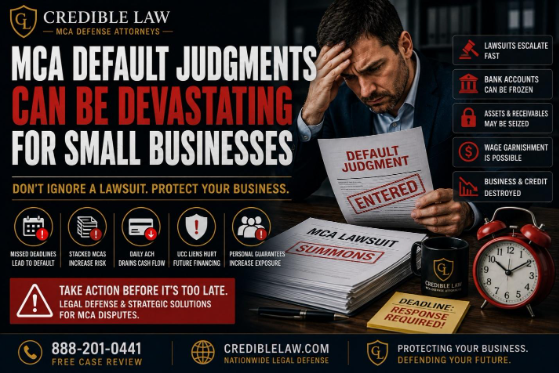
For many small business owners, receiving notice of a merchant cash advance (MCA) lawsuit is already stressful enough. However, one of the most damaging outcomes occurs when businesses fail to respond in time and a default judgment is entered against them.
Across the United States, MCA default judgments are becoming increasingly common as businesses struggle with:
-
stacked funding positions,
-
declining cash flow,
-
daily ACH withdrawals,
-
aggressive collections,
-
and mounting operational pressure.
Unfortunately, many companies underestimate how quickly these cases can escalate once legal deadlines are missed.
A default judgment can dramatically increase financial exposure and may lead to:
-
bank restraints,
-
frozen accounts,
-
aggressive collection efforts,
-
UCC enforcement,
-
wage garnishment in certain situations,
-
and severe operational disruption.
For businesses already under financial strain, the consequences can become catastrophic.
What Is an MCA Default Judgment?
A default judgment generally occurs when a business fails to:
-
respond to a lawsuit,
-
appear in court,
-
comply with procedural deadlines,
-
or otherwise defend against legal claims filed by the MCA company.
Once a default judgment is entered, the MCA company may gain significant leverage to pursue collection activity against the business and, in some situations, against guarantors as well.
Many businesses do not realize a lawsuit is progressing until:
-
a bank account becomes restrained,
-
collection notices intensify,
-
financing applications are denied,
-
or enforcement actions begin affecting operations directly.
At that stage, resolving the situation often becomes substantially more difficult.
Why Businesses Miss MCA Lawsuit Deadlines
There are several reasons businesses fail to respond to MCA litigation on time.
In many cases:
-
owners are overwhelmed by operational stress,
-
lawsuits are served during periods of financial instability,
-
businesses assume negotiations are ongoing,
-
or companies simply underestimate the seriousness of the legal process.
Some businesses mistakenly believe:
-
the MCA company will continue negotiating informally,
-
the issue will resolve through future payments,
-
or the agreement cannot be enforced.
Unfortunately, MCA litigation often moves quickly once defaults are alleged.
Missing even a single procedural deadline can significantly affect available defenses and negotiating leverage later.
How Default Judgments Escalate Collection Pressure
Once a default judgment is entered, MCA companies may pursue aggressive collection remedies depending on:
-
jurisdiction,
-
agreement structure,
-
guaranty provisions,
-
and applicable state law.
Businesses may suddenly face:
-
bank account restraints,
-
asset freezes,
-
intensified collection demands,
-
UCC enforcement,
-
receivables disruption,
-
and operational paralysis.
For businesses dependent on consistent cash flow, even temporary account restrictions can create severe consequences involving:
-
payroll,
-
vendor payments,
-
tax obligations,
-
and customer fulfillment.
Businesses experiencing escalating legal pressure often begin researching emergency resources related to Merchant Cash Advance Lawsuits while attempting to understand available legal options before operations deteriorate further.
Why MCA Stacking Often Leads to Litigation
One of the biggest drivers of MCA default activity involves stacking.
Businesses frequently obtain additional advances while prior positions remain active in an attempt to:
-
stabilize operations,
-
cover payroll,
-
resolve short-term cash shortages,
-
or maintain ongoing obligations.
Initially, the incoming capital may temporarily relieve pressure.
But over time, stacked positions often create:
-
overlapping ACH withdrawals,
-
escalating repayment obligations,
-
cash flow collapse,
-
and lender conflicts.
Eventually, many businesses reach a point where daily withdrawals consume most incoming revenue before core operating expenses can even be addressed.
At that stage, defaults and lawsuits often follow quickly.
The Role of Personal Guarantees
Many MCA agreements contain personal guarantee provisions that may increase exposure for business owners individually.
While the enforceability and scope of these provisions can vary depending on:
-
contract language,
-
governing law,
-
and factual circumstances,
business owners are often surprised to discover how broadly some agreements are drafted.
This can significantly increase emotional stress for entrepreneurs already struggling to keep their businesses operational.
Understanding the scope of guarantee exposure early can be an important part of evaluating overall legal risk.
UCC Liens and Financing Problems
Businesses facing MCA lawsuits often encounter additional complications involving UCC liens.
Many MCA companies file UCC financing statements shortly after funding.
These filings may impair:
-
future financing opportunities,
-
SBA loan approvals,
-
refinancing efforts,
-
equipment financing,
-
and commercial lending relationships.
For businesses attempting to recover operationally, multiple active UCC filings combined with default judgments can create major obstacles to obtaining stable financing solutions.
Businesses frequently discover the seriousness of these issues only after traditional lenders decline financing applications due to existing MCA exposure.
Why Early Legal Review Matters
One of the most important mistakes businesses make is waiting too long before seeking legal guidance.
Many companies delay action because they hope:
-
revenues will improve,
-
negotiations will continue,
-
or additional funding will stabilize operations.
Unfortunately, once default judgments are entered, available options often narrow considerably.
Early legal review may help businesses:
-
evaluate defenses,
-
assess reconciliation disputes,
-
review service issues,
-
preserve leverage,
-
negotiate resolutions,
-
or stabilize operations before collection pressure escalates further.
Businesses facing active MCA disputes frequently seek guidance from experienced Merchant Cash Advance Defense Attorneys to review agreements, assess litigation exposure, and evaluate potential strategies before default risks worsen.
Not Every MCA Agreement Is the Same
MCA agreements vary substantially regarding:
-
repayment structures,
-
reconciliation provisions,
-
default triggers,
-
ACH authorizations,
-
collection remedies,
-
and governing law clauses.
Some agreements may function more like future receivables purchases, while others contain characteristics more commonly associated with traditional lending arrangements.
Businesses should avoid assuming all agreements are legally identical or automatically enforceable under every circumstance.
The specific language and factual background matter significantly.
The Emotional Toll on Business Owners
The pressure associated with MCA lawsuits and default judgments often extends far beyond financial concerns alone.
Business owners frequently report:
-
chronic stress,
-
inability to sleep,
-
fear of losing the business,
-
strained relationships,
-
and overwhelming uncertainty about the future.
For entrepreneurs who invested years building their companies, aggressive collections and litigation can become emotionally exhausting.
This emotional pressure sometimes causes businesses to ignore lawsuits or avoid dealing with legal notices altogether, which often worsens the situation later.
Final Thoughts
Merchant cash advance default judgments can create devastating operational and financial consequences for small businesses already under pressure from stacked funding positions and declining cash flow.
Businesses nationwide are increasingly experiencing:
-
lawsuits,
-
frozen accounts,
-
aggressive collections,
-
UCC complications,
-
and financing denials tied to MCA obligations.
Understanding the risks associated with missed legal deadlines and default judgments before the situation escalates further may significantly affect available options moving forward.
For businesses facing MCA litigation, early evaluation of agreements, repayment structures, and legal exposure can play a critical role in protecting long-term operational stability and preserving future business opportunities.